Bengle飞翼设计想法
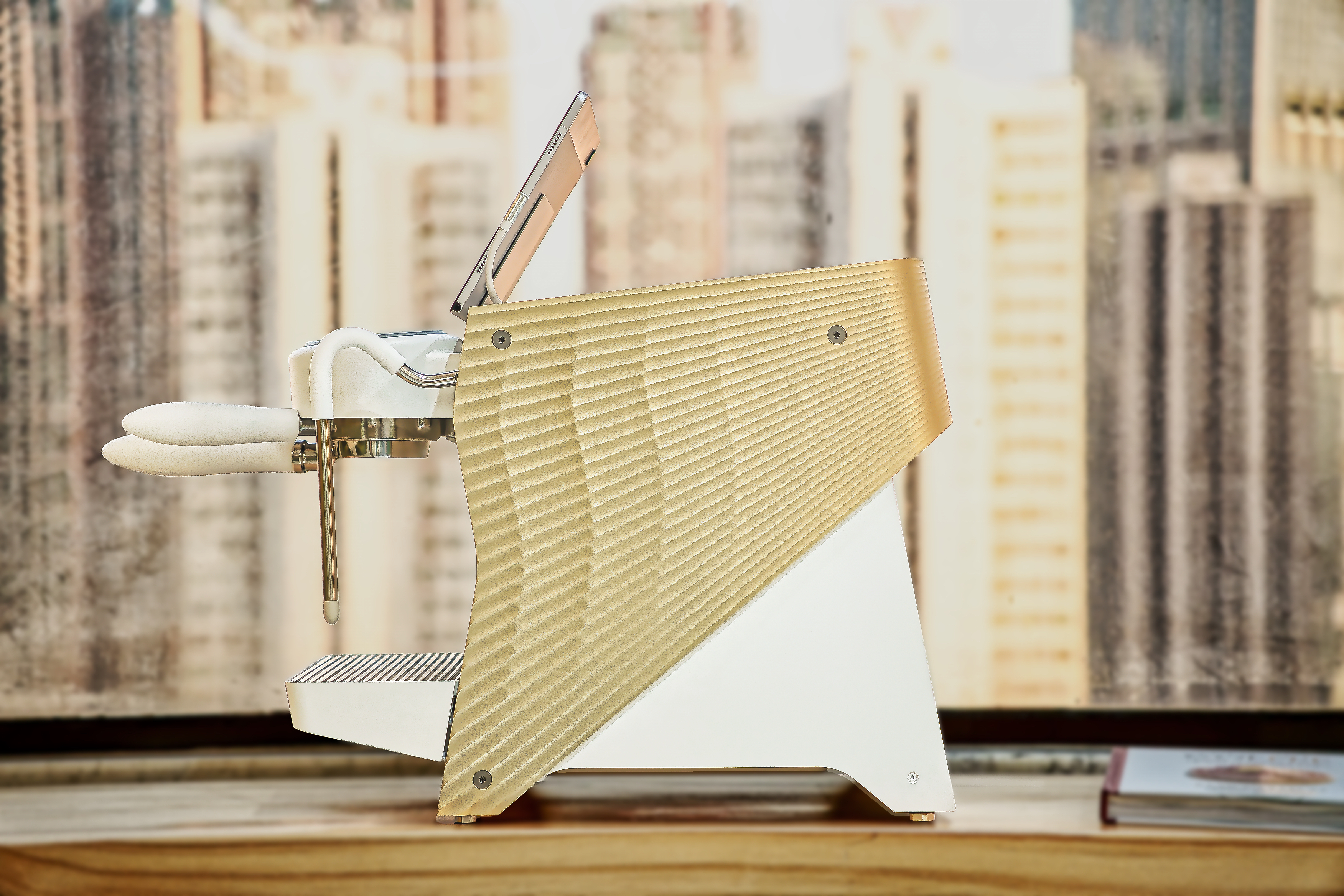
在本文中,我将解释我们如何受到艺术家 和尖端工业机器控制的启发,创造出新款意式咖啡机的外形设计。
我们的 Bengle 意式咖啡机采用流线型的弧形木质外壳,其灵感源自于 Charles 和 Ray 设计的Eames座椅.
我们的目标是为Bengle打造一款造型,其灵感源自意大利意式咖啡机设计的黄金时代。我们希望创造一款既具有时代感又深深植根于其历史背景的金属制品。我们希望设计出一款能够引发人们遐想:“我以前在经典的意式咖啡机上见过这种设计。不,我并没有,但感觉好像见过。”优秀设计师Ben Champion从这款高端刀柄流畅的曲线中汲取了灵感。

The curves have a natural quality to them, reminiscent of art deco.
Researching how this was made, Ben found articles about controlling milling machines directly instead of relying on CAD software to do so.
Clean, soft curves are usually impossible (or extremely expensive) with CNC because the CAD software converts those shapes into slow back-and forth motions using fine tools. This process is not only very slow, but it also leaves slight grooves. Also, creative possibilities are limited as the CAD software usually avoids "artistic" milling tools, and carves with the tool at 90º to the surface.
With direct control of the milling machines, however, creative possibilities greatly expand. You can use different carving tools for vastly different effects:

You can adjust the angle of your tool as it meets the metal surface. There's no reason your tool has to be perpendicular!
I wanted our design to hark back to the Art Deco sculptures I saw while drifting through museums in Paris during my time at university. This aesthetic spoke to me in particular:


The first step in creating the Wings design was to define the 2D back-and-forth path that the tool would take, as well as its travel speed and angle.

Then draw a 2D line to define the tool's up-and-down motion over time.

Make one, then iterate.

As this excellent article on the process explains:
In general, all of the tests/techniques were successful to some degree, however some of the results were rather predictable. The more interesting aspects (converging paths, overlapping and distorted areas, various depths, etc.) seemed a result of unforeseen factors (not controlled in Rhino or Inventor HSM). These occurrences seemed to yield particularly rich areas in the aluminum - where texture and visual affect are amplified.
Serendipity plays a significant role in this process. While some things don't work as expected, others turn out to be vastly better and more interesting. For example, we achieved particularly good visual results when experimenting with tool angles and depths.
The final step is to bend this flat shape by hand without damaging it, so it fits on the espresso machine.

Ultimately, this object is milled in three passes, with different tools and paths used each time. Human post-processing steps, such as sandblasting, painting, drilling and bending, all have to be perfected. We decided to make it in both silver and gold, as each color had its own virtues with this design.

The entire process took 18 months, during which time Ben collaborated closely with our manufacturing partner and his expert machinist to bring this project to completion.
We're very proud to have created something that is not only new to espresso, but also to medium-to-large-scale manufacturing. We have not seen any other company use this approach for anything other than small objects and short manufacturing runs.
The process was very R&D-intensive, unpredictable and creative. We loved doing it, and we hope you enjoy having it in your home, should you decide to purchase it.

- Written by John Buckman and Ben Champion
jwang created 2026/03/25, updated 2026/04/28